Showing posts with label children's books. Show all posts

Sunday, 17 January 2021

The Wolf in Underpants. Wilfrid Lupano (text), Mayana Itoz and Paul Cauuet (illustrations)

Nothing is as it seems but the creation of fear can condition how we see things and therefore, how we choose to live and behave. 

The Wolf in Underpants (Le Loup en slip) was originally published in French in 2016. Meanwhile, four further parts have been released, three of which are available in English. The graphic novels are humorous, clever and critical, endearing the reader to the wolf and the other forest animals - the squirrel, hedgehog, etc who all assume different social roles.


The animals in the forest are in for a surprise when they are confronted with their biggest enemy and fear - the Wolf. It turns out that the Wolf isn't what they have imagined and so, little by little, they are waking up to a new questioning of things and their role and place in the forest.. but are they really ready to confront the contradictions that lie within them and open their eyes to the machinery of manipulation they are trapped in?

There are not that many books that manage to charm both adults and children. This graphic novel series is one of them with a fun mystery for kids to solve and deep underlying social questions that need urgent answers or at least reflection of how our societies are constructed and the manipulations we are all subjected to, sometimes willingly or complacently. the many graphic scenes allow the kids to follow different trails and take different paths, while the common thread of the wolf and his interaction to the forest dwellers lend unity and complexity to the story. 

The choice of the starring wolf..in underpants to booth, lends a light note to the story and subverts this classical baddie figure. The wolf remains mysterious..after all, he is still a wolf..but it is no longer solely the villain but a complex figure that invites both young and old to reflect on their prejudices or preconceived ideas and distance themselves from the status quo...things are never simply black vs white, the complexity and ambiguity lie in each and every one of us, capable of harming and being harmed. 

A funny graphic novel with a sharp, critical social message and an invitation to confront our fears and dare to think differently. Intelligently and wittingly done to attract both kids and adults!


Volume 2 . The Wolf in Underpants freezes his buns off (Le Loup en slip se les gèle méchamment)


This follow-up to the Wolf in Underpants was published one year later , in 2017. It is equally witty and mysterious, inviting the reader to follow the forest dwellers in their quest to find out why the wolf is in such a bad mood, what they can do to keep him from turning wild again and who is actually freezing.

It's now bitterly cold in the woods and business is in full swing - coats to keep you warm, fondue and bread galore to keep you stuffed and lots of pleasure for those with the means - sauna, ski, etc. But all of this comes at a price...and not everyone can get their hands in or near the coffers. Once more, a  - machinery is in place - cheese factory, bakeries - and it's up to the wolf to open the eyes of the forest dwellers, blind to the inequalities and injustices which have taken root.

While trying to solve the mystery, the useless anti-wolf brigade is once more called in (after all, they pay a lot of money to feel and be safe) after the dwellers' efforts at appeasing the wolf and his coldness (hat and socks are knitted for him by the Independent Owl) prove futile. Together with all the scared, curious dwellers, they march up to the wolf's house on top of the cliff, demanding to know who or what exactly is freezing.

In this second volume, critique on social inequality is much more starkly underlined. The social message is clear - if you don't share, you are all doomed..sooner or later and the forest can be a much better place if we step out of our little worlds and observe how our actions and lifestyle affect those around us..

the Elk Professor (read purveyor of capitalism) however doesn't see why anyone needs to feel bad about their hard-earned and therefore well-deserving wealth...to which the Wolf holds up a STOP sign.

He reminds all the dwellers that the cold 'can make you look frightful, with fangs like ice picks...'

We can never be safe and contented with our well-deserved wealth if there is suffering and misery in our midst..they feed off each other..so the dwellers had better learn or watch out..

Is this a lesson we want to and are ready to face?? Too big a question for one book to answer. 

This volume is a welcome introduction to discussing many environmental and social topics in an easy, fun and friendly way.  With small changes, the system can be mended..but what if it's the system that is the problem???? 

Saturday, 18 July 2020

Looking for the familiar in the foreign

First of all, I resent the book I am going to quote from - Jim Knopf und Lukas der Lokomotivführer (Jim Button and Luke the Engine Driver). It was originally published in German in 1960 to great acclaim by the now famous writer Michael Ende. In the 1960s, many African countries were either still reeling under the burden of colonialism or slowly waking up to the challenges Independence from their colonial superiors brought. If we read Jim Button in this historical context (the book appeared in English in 1963), then it's not surprising that the portrayal of Blackness is dehumanising and degrading. I resent the way the Black young figure emerges in the story and I resent the portrayal of his blackness.

What I resent the most, however, is the naturalness and panache with which the narrator describes the discovery of the black baby in a package delivered by the mail man and the naming and appropriation of the baby (Jim Knopf) by the white lady Frau Waas who lives there. Jim Knopf is domesticated and regularly washed (although not educated - that would either be too dangerous or no good at all) and is taught the language and the habits of the few inhabitants in Lummerland so that he easily becomes one of them. From then on, his darkness is rarely mentioned and what takes centre stage are the adventures he encounters on his journey with his darkened best friend Lukas the train driver. The story is, in effect, a wonderful travel narrative that awakens the imagination of a child and her/his appetite for adventure and risk-taking. However, dubious and downright harmful representations of the other - Black, Asian - are harmlessly interspersed in the story and this is where the problem lies - the gullible, vulnerable, impressionable child reader absorbs them easily and they float around in the imaginary, and are reinforced in different ways in different picture books that are widely available and are shared and loved and read in the system here (homes, schools, libraries), so that after a few years, the reader can proudly appropriate these 'harmless' references as 'truth' about the peoples described!.


Lucia Vidales Foreign and Familiar

Having stated these reservations, I would still like to quote a beautiful and telling passage from Michael Ende's Jim Knopf Part 1 in which Lukas and Jim arrive in the land of Mandala and are invited by one of the inhabitants (who turns out to be a 1 year old child!) to a meal. Food has long been a motivator to bring cultures together or set them apart. We attach nationalities to food and associate certain ingredients/dishes with certain cultures or countries - Iberian ham to Spain, curry to India, kebap to Turkey and so on. We are also enchanted, disgusted or amused by different specialty dishes in different parts of the world - fried insects, snails and frog legs, dog and other wild animals, alligators, etc. Food is such an intrinsic part of a culture and people and here, in the following passage, we see how familiarity, expectation, fear of the unknown, reciprocal distrust are all nicely packed in the conversation between the inhabitant of Mandala (inviting the foreign guests to a meal) and Lukas the train driver (curious to know what there is to eat):

'Und was darf ich den ehrenwerten Fremdlingen nun zu essen bringen?'
'Ja', meinte Lukas ein wenig ratlos, 'was gibt's denn?'
Der kleine Gastgeber begann eifrig aufzuzählen:
'Vielleicht hundertjährige Eier auf einem zarten Salat aus Eichhörnchenohren? Oder möchtet ihr lieber gezuckerte Regenwürmer in sauerer Sahne? Sehr gut ist auch Baumrindenpüree mit geraspelten Pferdehufen überstreut. Oder hättet ihr gern gesottene Wespennester mit Schlangenhaut in Essig und Öl? Wie wäre es mit Ameisenklößchen auf köstlichem Scheneckenschleim? Sehr empfehlenswert sind auch geröstete Libelleneier in Honig oder zarte Seidenraupen mit weich gekochten Igelstacheln. Vielleicht zieht ihr aber knusprige Heuschreckenbeine mit einem Salat aus pikanten Maikäferfühlern vor?'

After exchanging glances with his travel companion Jim and explaining to their host Ping Pong that they have only just arrived in Mandala and need time to adjust to all those surely delicious delights (squirrel ears, earth worms, mashed tree bark, horse shoes, snail sauce and ant rolls, dragon fly eggs, silk worms, tender hedgehog prickles, beetle antennae or grasshopper legs) Lukas the train driver tries to get Ping Pong to offer him something of comfort and familiarity:

Gibt es denn nicht vielleicht etwas ganz einfaches?, asks Lukas
to which Ping Pong replies, 'Oh doch!...zum Beispiel panierte Pferdeäpfel in Elefanten-Sahne'.
'Ach nein', sagte Jim, 'so was meinen wir nicht. gibt's denn nicht irgendwas Vernünftiges?'
'Irgendwas Vernünftiges?', fragte Ping Pong ratlos. 

But then Ping Pong's face lights up and he adds, 'Zum Beispiel Mäuseschwänze und Froshlaichpudding.. das ist das Vernünftigste, was ich kenne'.
But Jim isn't convinced with the exotic offfer and tries again to explain to Ping Pong what he means by a reasonable meal:
'Ich meine zum Beispiel einfach ein großes Butterbrot'.
But Ping Pong returns a confusing look and admits he doesn't know what Butter and Bread is.
Lukas tries again - 'Oder Bratkartoffeln mit Spiegelei'.
But Ping Pong shakes his head. Nope, never heard of potato and eggs!
Lukas goes on - how about a piece of Swiss cheese?, and his mouth is already watering.
Now Ping Pong is appalled - but that's mouldy milk! 'Would you all really want to eat something like that?, he asks, dismayed.

Then Lukas finally remembers that they are in Mandala and in Mandala there is rice. They would love to have some nice plain rice! When Ping Pong hurries to get them their dainty dish, Lukas reminds him- - without beetles or shoe laces if possible!

The little bowls are hurriedly brought out and the next dilemma begins - eating rice with chopsticks! They soon give up and pick up the tiny bowls directly to their mouths - es gab roten Reis, grünen Reis und schwarzen Reis, süßen Reis, scharfen Reis und gesalzenen Reis, Reisbrei, Reisauflauf und Puffreis, blauen Reis, kandierten Reis und vergoldeten Reis.

What an enchanting passage into the world of food and culture. What constitutes a simple dish? A sensible dish? Bread and Butter! Everyone must know about bread and butter or potatoes with eggs! It is in this fascinating world of food where we can reflect our insecurities and fear of the unknown, our narrowness and inhibitions, our taboos and prejudices, our retinence and yes...where we can also find common ground, a space to discover and love, to cross our established boundaries and make the foreign familiar!

Thursday, 16 April 2020

Diversity without the Label

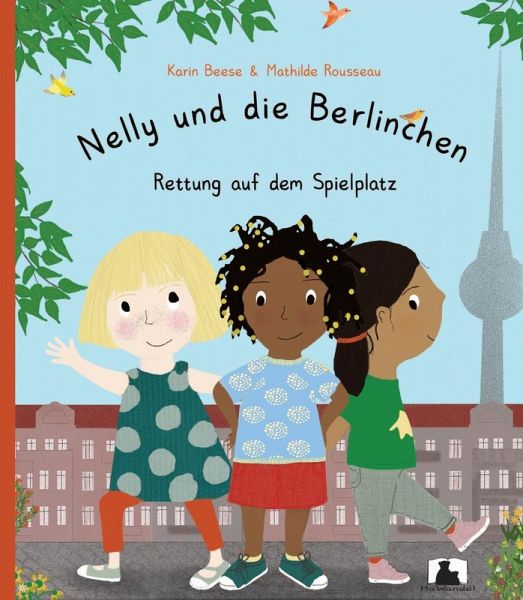
In Conversation with Karin Beese, Author of the Nelly und die Berlinchen Series


Nelly und die Berlinchen
 In 2019, 'Treasure Hunt', the second book of the Nelly series, was released.
Author Profile

Karin Beese grew up in Sachsen, Germany. 
She studied Communications and Mathematics in Dresden. Beese has worked in environmental politics and development for many years and currently lives and works in Benin (since October 2019). 
She is the founder of the HaWandel Label and has worked with producers in Cameroun to create a fair and transparent pricing system for their products. She is the mother of three girls and her interests include diversity and empowerment, global justice and sustainable environments.


The author was kind enough to answer the questions below and talk about her first experience as a writer of children's books. I have previously discussed her first Berlinchen book in one of my earlier blog posts entitled 'Being Different being me' which you can read here.


Can you please introduce the Nelly und die Berlinchen series to our readers?
Nelly und die Berlinchen is a Berlin-based imaginative picture book series. Pre-schoolers can immerse themselves in the everyday adventures of the three friends Nelly, Amina and Hannah. Written in verse, the Berlin girls are never out of ideas. They have fun, disagree but always work out their problems together. The books present non-discriminatory diverse illustrations with special attention to skin colour, religion and family structures. They focus on friendship, family and the environment in the lives of children and bring a smile to the faces of parents and older siblings.


You crowdfunded and self-published the books. Why?
We crowdfunded the printing of both our Berlinchen books. We first wrote to big publishing houses but waited for months without a reply. What’s more, we had heard that publishers sometimes quite heavily influence the book’s layout and we really wanted to maintain our independence. That’s the reason I started my own small publishing house, HaWandel. It was actually quite simple but of course, a great risk as well. I had to self-finance the printing of the first edition of the first Berlinchen book. The positive feedback from the crowdfunding initiative was very encouraging and I rounded this off with my private savings to finish the project.


What was the reception of your two books like?

The feedback for both Nelly und die Berlinchen books has really surpassed our expectations. Even now, four years after the first publication, we still regularly receive mails or online reviews of our first book and people all over Germany thank us for creating it – parents joke about being sick of reading the story to their kids or we hear from grandparents who are grateful for having finally found the perfect birthday present for their grandkids. We also receive quite moving responses, like that of a mother whose daughter can’t get enough of the book because there is finally a father in it who looks like hers! Our experiences through reading presentations also help us appreciate how differently kids relate to the individual characters of the book. We intentionally created open characters. In the second book of the series, the mother of one of the Berlin girls is pictured together with another woman. While for some kids it is obviously the grandmother, for others it is clear that it’s the mother’s girlfriend. That’s the beauty of the two Nelly und die Berlinchen books – children have a lot of room to use their imagination and creatively identify with the characters.


Beese introduces her books and their context in German on her website hawandel.de


Why do you think there are so few Black protagonists in German picture books? Is there opposition from publishing houses?

To be honest, I really cannot say. You could reach that conclusion when you look at the books out there. On the other hand, established publishers choose on average one out of every 200 book propositions and I have no idea how many authors create books with Black protagonists. There is definitely not enough of such books and it is very important that more authors create them and customers explicitly request them. In the last few years, I have received requests from authors asking if I could also publish other books with very diverse characters. That was not originally my plan but I certainly can see myself doing it. But it should be books like Nelly und die Berlinchen - creative stories which reflect diversity in the everyday lives of children and not books that ‘explain’ that we are indeed all equal. I believe a lot of new books are being created at the moment and I would be happy to work with the authors.


How would you describe the current situation of racism and discrimination in Berlin/Germany?

Racism and discrimination are big problems in Germany and also in many other countries. There are of course local and regional differences but the underlying difference is really whether racism is more direct or indirect. Black people and People of Colour are considerably affected, as a result. Many families I know, for instance, carefully consider their holiday destinations because they want to feel comfortable and safe where they travel without being constantly stared at. There are of course also positive trends in politics and increasing numbers of individuals and companies that are actively engaging with diversity and intersectionality. At the same time, the discussion continues to overwhelm a lot of people and therefore the gap between an engaged discussion and its rejection is becoming wider.


What is needed, in your opinion, to advance the debate here? What role can children’s books play?

We need to become more actively engaged in showing and reflecting what real diversity in Germany and Europe could look like on the ground, in everyday situations – in television, in the news, in cinema and also in children’s picture books. We unfortunately continue to see the same stereotypes being reproduced. One of my daughters once asked me whether women or dark-skinned people could also be police officers. I immediately went in search of picture books with Black or female police officers, which in Germany, is almost non-existent.

Kids love books and books influence at a very young age how kids perceive the world. This is why diverse characters aren’t only important in empowering Black kids or Children of Colour but also white kids. When I identify with a brave, sporty girl in a book and her mother wears a head scarf, the next time I see such a girl at the playground, I would also want to get to know her instead of being sceptical. It is also important that diverse characters are not always presented as perfect or always doing the right thing. Diversity is not ‘good or bad’ but simply normal.


Fotogalerie
'Saving Teddy', the first book in the series, was published in 2016

And finally, what is your favourite children's book?


Der kleine Angsthase - The little scared rabbit (Angsthase also means scaredy-cat). I’ve loved this book since I was a child! It is comforting to see how the little rabbit overcomes his fear and even protects his small friend from the fox. It is nonetheless a pity that he first has to be a ‘hero’ before he is accepted by the other rabbits. What’s funny is that our youngest daughter identifies with the fox and doesn’t like it when he is chased out at the end. It is great when a picture book presents different characters you can identify with or where children can put themselves in the shoes of others.

Wednesday, 15 April 2020

Homemade Love by bell hooks


Decolonising the Imagination


Hardcover Homemade Love : Picture Book
This picture book was published in 2002 and is intended for ages 2 to 6 years. hooks' first children's book was titled 'Happy to be Nappy' and was released in 1999. In 2008, hooks published Grump Groan Growl, a book that embraces the myriad feelings children experience and a warm acceptance of rage and anger.


‘Any Black child that has a healthy self-esteem will know how to deal with racism…any White child that is taught to be loving is not going to be a racist’ (hooks)


'the media has bomdbarded us with stories telling the public that little black children (and we are talking here primarily about girl children) prefer white dolls to black dolls, and think that white children are cleaner and nicer. The white-dominated media presents this knowledge to us as if it is solely some defect of black life that creates such aberrant and self-negating behavior, not white supremacy' (Sisters of the Yam, bell hooks)


bell hooks emphasises the role of imagination in resisting domination. I have the impression that nowadays a vast majority of picture books are unimaginative. They do transport you into wonderful imaginary worlds but many of them leave you wanting and yearning....for blonde hair and blue eyes; they leave you with a dislike for things that are brown and black, they leave you with a void and a confusion and with a vocabulary that doesn't necessarily fit your world. My brown-skinned 3-year-old picks up a light pink coloured pencil and says convincingly that it's the colour of skin. My five-year-old always colours the girls' hair blonde because it's more beautiful, she tells me and my little one protests or cries when I try to colour a face brown or black. 


White Supremacist Capitalist Patriarchy – big words that have become hollow from use and misuse. But not with bell hooks. Homemade love is about empowerment and resistance…but without the floodlights, loudspeakers and fanfare of 'diversity'. It is about resistance through love, healing, bonding…and all of this packaged and illustrated in a playful, flighty, poetic, kinetic style that opens up the book and invites the reader to partake in, seek out and sow this seed of love.


Reading the picture book Homemade Love with my kids is a simple act of joy and sharing. My little girl laughs with the girlpie protagonist hanging from her daddy’s legs and my older one happily reads aloud with me, ‘there is no all the time right. But all the time any hurt can be healed’. Homemade Love is a little big book with deceptively simple sentences that lets children know that they deserve and have a right to be loved. Making mistakes is part of life, hurt can always be healed, peace can be made again with the world… and the tender support of parents in guiding and loving us through all of this is crucial.

Girlpies have the space and cosiness at night-time to process all the things they experienced during the day. In this space of safety, love and alone-time, the little girlpie knows her place in the world, isn’t afraid of the dark place ‘cause everywhere is home’. 


My 5-year-old asks me at the end of our reading, ‘is it true that everywhere is home?’. Oh yes, I say. This comforting well-being that you carry within you…this little ‘Lichtergarten’ (our lit-up inner garden’) as Soheyla Sadr puts it in her picture book ‘Anne und Pfirsich’ is all the ‘home’ we need for self-actualisation, …to imagine and realise our world and to be at one with it.


Shaking Binarisms out

‘We live in a nation that is incredibly diverse but our language is incredibly binary…so we have to work to be inclusive’, notes bell hooks in an interview with Connie Doebele. And this is what bell hooks’ picture books do – they twist the language out of this binarism, let the words jump up and out at you. The words are ventilated, become almost free for each and every child and parent to dwell on, caress or interact with. 


The starting point of Homemade Love isn’t diversity or any of the other catchwords that we parents latch on to in the hope that our children can experience the diverse world that we live in. bell hooks is wary about children's books that start off with a negative - 'my hair is unruly and difficult to manage but I love it just the same'...'I am told by my classmates that I can't be Peter Pan because I'm not a boy and I'm Black but I'll show them'..and the list of examples go on and on. Too many of our children's picture books are stuck in this binarism; telling Black kids and kids of colour that the world is a harsh place for them, that they are not seen as equals, something is 'wrong' with their hair, their colour, their smell, their origin, their religion...but 'WE' will be your friend DESPITE this. We may have been decolonised but the minds and imaginations are still reeling from the stupor of colonisation.


‘How do we use our imagination in the service of our well-being?’, hooks urges us to ask ourselves. When the girlpie protagonist of Homemade Love lies in bed at night, knowing she is loved, knowing the arms that held her are still holding her, she is equipped to be at one in and with the world.

bell hooks has often joked – ‘I’m not happy, I’m an intellectual, how am I going to write books for children?’ But she recognised the energy inside her and wanted to manifest it because kids and more importantly, Black kids and kids of every colour desperately need to see this seed inside them, sow it and enjoy its fruits. Only then can our children begin to see their worth and potential and react to the many hurdles that they face daily.


And finally, I'd like to quote this lengthy passage from hooks' self-help book 'Sisters of the Yam', It shows the depth of the short statements we read in Homemade Love and the deeper meanings behind some of them. In this quote, she talks about embracing darkness and instilling a love for and comfort in it, especially among kids:


In a space before time and words, the world was covered in a thick blanket of darkness. It was a warm and loving covering. Since it was hard for the spirits who inhabited this space to see one another they learned to live by and through touch. So if you were running around lost you knew you were found when arms reached out in that loving darkness to hold you. And those arms that held the spirits in that beautiful dark space before time are holding us still. This is a little origin story I made up. I thought of it one day when I was trying to explain to a little brown girl where the babies lived before they were born—so I told her they lived in this world of loving darkness. I made up this story because I wanted this little brown girl to grow up dreaming the dark and its powerful blackness as a magic space she need never fear or dread. I made it up because I thought one day this little brown girl will hear all sorts of bad things about the darkness, about the powerful blackness, and I wanted to give her another way to look at it. (bell hooks, Sisters of the Yam, pg 92)