Tuesday, 13 April 2021

Germany's template for diversity in children's books??

 Let's look at the text for this picture book that was originally published in French in 2003. The German translation was published in 2016 under the title 'Alles lief gut'. Author, Franck Prevot


                                                        Everything was going well...for whom?


Alles lief gut...

...als etwas sonderbares ankam!

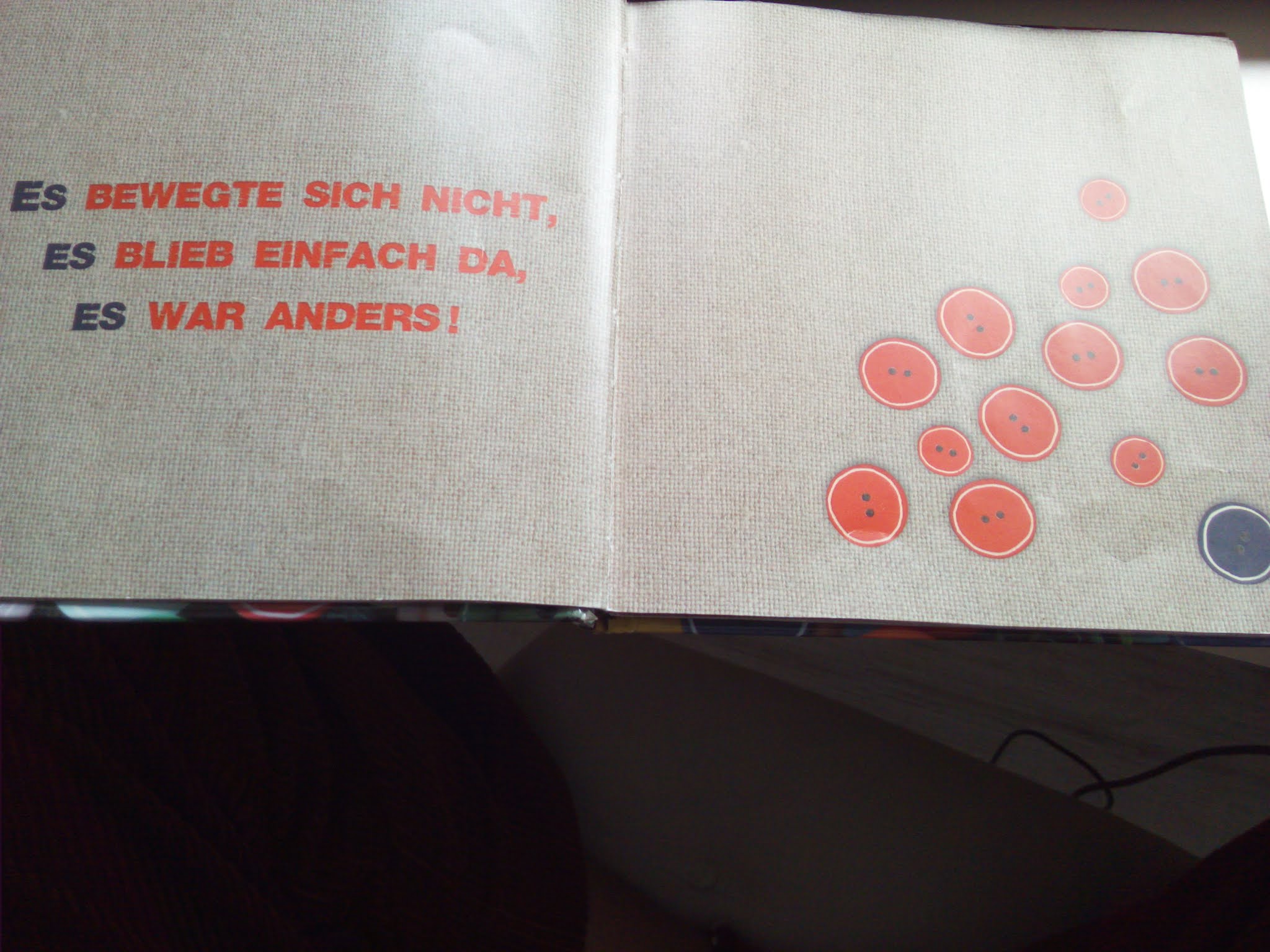
es bewegte sich nicht, es blieb einfach da, es war anders! 

es kam näher, bedrohlich, bereit, unseren kleinen zu verschlingen. 

es sprach zu unserem kleinen. 

und unser kleiner lachte. komisch! 

Wirklich! komisch!!! 

Wir haben es irgendwo hingetan, wo es nicht störte. 

dann sind andere gekommen, fast gleiche 

eines tages kam es heraus.

wir haben es überwacht (the three small black buttons are in the centre of the circle of red scattered buttons)

und dann haben wir nicht mehr darauf geachtet. 

es ist gewachsen und alles lief gut, im grunde 

alles lief gut... (now the print is both red and black and the buttons are mixed around the page)

...als ETWAS sonderbares ankam! (the ETWAS is a black and silver button)

(END OF TEXT).

Summary of text

A homogeneous group of buttons are comfortable, safe and happy until a strange black button appears and threatens to disrupt their space. The red homogenous community of buttons is distrustful, suspicious and wary so they ignore and try to separate the black button(s) from the red buttons. This takes place after they see a small black button speaking to one of the small red buttons and the latter being receptive. Although they take pains to separate and keep watch on the black buttons, they soon let their guards down until it's too late..the black buttons have managed to mix in with the red buttons, disrupting their homogeneity. Nonetheless, everything was going well...until another STRANGE button (black with a grey centre) shows up. And the reader is left to imagine the same process of first shunning, being wary and suspicious, pysically trying to separate the intruder from the community until they somehow manage to slip out from the space they are restricted to..and mingle with the rest of the buttons.

For a white reader accustomed to these dominant representations of self (white, middle class) and other ('coloured', usually from a lower class so they are less threatening with no power or agency), it comes as no surprise that the book has been praised and eagerly introduced in preschools to teach acceptance and diversity. For a disempowered person or someone who rarely sees themselves represented in children's books, this picture book is disheartening, arrogant, pretentious and promotes the negative stereotypes and prejudices associated with being an outsider in any community.

It maddens me to see such words and images appearing in association with a newcomer (physical separation, suspicion, distrust, xenophobia) because it reinforces these feelings in the reader even though in the end, all turns out well. The damage is already clearly done and the minority is left without a voice, having all these negative representations piled on him/her.

I have seen too many books following this format...with its arrogant eurocentricity and power to stuff and stifle the representation of difference into a small place that is tolerated but left under suspicion and not completely trusted because after all, 'they are just too different and can never be like us'.. this paternalistic view is corroborated over and over in picture books - we (white, middle-class) are tolerant, accept the outsider and charitably welcome them and they in turn, know that their place is not really beside us, but under us, accepting our charity and goodwill.

In the following post, I will look at the renowned children and youth writer Paul Maar, known for his fantasty-full fictitious character Sams and see how he handles the refugee influx in Germany and in the school system. Another disappointing example that fits the 'alles lief gut' model!

Friday, 22 January 2021

Seeing the world from the eyes of a dog

Calling things by their name. Hello, Dachshund Tom, by Bette Westera and Noelle Smit (original in Dutch)


'Your legs are way too short, laughs the cat

Not at all, retorts Dachshund Tom, the box is just too tall'

Dachshund Tom cuddles in the warm woollen blanket with his other dog siblings and mother, it smells of comfort and security and of his mama, who has just come from outdoors. The doorbell rings, Mama Mira rushes out of the box and Tom's world is changed forever. After looking at all the pups, the men choose Tom. She is put in a strange, cold box without a warm woollen blanket and taken away. 

But Tom is no ordinary dog- he is cheeky, brave and curious.

'We'll take him', says the strange man. 'what's his name?' 'You can choose a name yourselves', says his owner. 'What? But my name is Tom', thinks Dachshund Tom. 'You do know that.'

The adventure of his new life with a new family is about to begin. Pablo and Paul arrive home and present Tom to their daughter Sophie. She is ecstatic and the confused Tom must quickly orient himself in this new world. The men tell Sophie she can choose a name for her new friend, but Tom thinks, 'hey guys, I already have a name'.

With warmth, humour and innocence, Tom adjusts to his new owner and family and with Sophie by his side, he is suddenly less lonely and ...at home.

It's wonderful to view the world from the eyes of a dog about to have his life catapulted into the unknown. Not any dog, but a little sausage one, with short legs, a stubborn determination and a healthy curiosity..a dog who knows his name and holds on to it. He snaps at the stranger who has come to upset his new world with his siblings and mother and woollen cosy blanket. He insists his name is Tom and wonders why the family picks up his poop or are surprised by his wee - 'Do you really find that strange?', he thinks.

Just like this baby dog who has to slowly learn to understand the world of people and have himself understood in it, a child will relate to the confusion, fear, frustration and curiosity of Tom, the dachshund.

A wonderful book that carries you on a little journey that forces you out of your comfort zone, invites you to see the world from the eyes of another and to remember who you are. 

Sunday, 17 January 2021

Small Actions that Make a World of Difference: Peter Reynolds: The Dot and Playing from the Heart.

 'Just make a mark and see where it takes you', the Teacher tells Vashti


Sometimes in life, we are lucky enough to find an adult in Institutions who believe in us and invite us along a path towards self-discovery and empowerment. We all know the huge influence adults have in shaping the lives of children in their care, whether directly or indirectly. Children look up to them in their formative years, believe in and hang on to their every word - whether harmful or healing. Of course, there are countless cases of children defying the negativity transmitted by adults to prove they cannot be placed in a box and labelled FAILURE. 

This book emerges from the trendy, hugely popular American strain of empowerment books for kids. Kids need to be motivated, kids need to be encouraged, kids need to see light when they are in the dark...and when they do, they will spread this light to others, making our world a better place. What a lovely message..and the dot, a little black mark on a white page can become and assume the dimensions we give to it..if only we dare to try, if only we are given the first nudge in the right direction. 

'Well, maybe I can't draw, but I CAN sign my name', thinks Vashti

Little Vashti is hopeless at art. Her teacher believes in her student and encourages her through kindness and support. It's up to Vashti to discover her skill and the teacher  is ready and waiting to showcase it to..everyone. Meanwhile, Vashti is now convinced that art and any other talent is there to be discovered and appropriated...yes, by anyone!

'Hmmph! I can make a better dot than THAT!'

...

'If I can make little dots, I can make BIG dots, too.'

A feel-good book, playfully and colourfully illustrated. The drawings stay away from explicitly identifying and limiting the work to ethnicities and skin colour..and the name Vashti is able to free itself from any /foreigner/ethnic undertones. In this sense, the book appeals and reaches out to all kids, without falling into the trap of 'immigrants'=underprivileged or  'immigrants'=disadvantaged, and therefore needing the benevolence of authority and institutions to patronise them. 

A simple message that is cleverly illustrated which helps it to soar across and make borders more porous.

When one person is inspired, it never stops there, in fact, we never know where it will end and what it will spiral into. So leave your mark and ...sign it, tells us Peter Reynolds.

Afterthought - This is a simple book introducing kids to colours, frustration, patience, motivation, hard-work and reward. The underlying message is we all have the potential, we just need the nudge and encouragement to explore it or find it. There are so many kids who succumb to pressures of all kinds - class/social inequalities, unrealistic, demanding expectations from adults, peer pressure, etc and who never get the chance or opportunity to find their true calling, if there is really something like that. In this light, the book is a celebration of the free spirit and pays hommage to teachers and adults that encourage children to find their own path.

However, in all honesty, although the message is quite inspirational, the book itself lacks real creativity and this is something that is very common in children's books - creativity becomes a hostage to a message we think kids desperately need - a message of hope, of love, of caring, etc. In other words, while it pays hommage to this one child's creativity, it actually does so in an ...uncreative way-

Children do need positive examples and role models, they do need to see positive self-representations reflected back at them...but I wonder if that's enough, if we are selling them short...


Playing from the Heart - Peter Reynolds

'Could you play a song for me?'


'these notes reminded him of zoo animals peering through bars...wanting to escape'

On the back cover, there is a note from the author, which I reproduce here:

'When I wrote this story, I hoped it would resonate with those who are looking to be reminded to be playful, to channel joy- not perfection. Then it took on new meaning when my father suffered two strokes. Seeing him in discomfort, I wanted to see that sparkle in his eyes again. there were no words. Just feelings. Like music'.

Here we have a writer who comes close to losing his father and explores the use of music as a way to connect people in times when words or actions may seem futile. 


A boy named Raj slowly grows up and has all but forgotten the love and passion with which he played the piano. The piano, this instrument sitting in the living room, this connection of joy in silence, without words, between father and son. The son moves out, has his own successful life and receives a call one day informing him that his father is sick. He immediately leaves in the pouring rain to see his old man. Will music - that one thing that stood long ago as a symbol of their bond - be able to revive their connection?

'His father heard the dreamy music floating through the house. He was amazed that his son was playing beautifully without ever having taken a lesson'

... 'Although Raj played better and better he got more and more tired...until the day that even looking at the piano made him exhausted'.

Playing that song without a  name

What do you do when you think you see a talent in a child, you invest a lot to nurture this talent, the child goes along, having fun, probably wanting to please you, and after the child has also invested a lot of time and energy and patience and is doing well, (s)he suddenly gets tired and then...stops altogether?

How easy is it to accept this, not label it as resignation, failure, lack of discipline, laziness..and trust that the child has the right to follow the path (s)he has chosen?

Having expectations, becoming disappointed or frustrated or even angry and violent when they are not met, dealing with all these emotions in a healthy environment and trusting that passions are things that never die, they just lie low sometimes, ready to burst back out when we least expect it. Killing or stifling or deforming this passion is one of the great harms we adults can sometimes do to kids, even with the best intentions. 

'Finally, Raj closed the cover over the keys. He was finished. The piano was silent'.

Years later, 'Raj found the sustain pedal and dove into a place he had not been in many years. The notes emerged whispery and sweet'.

Afterthought: I like the idea of having a close but silent relationship between a father and a son, one characterised by loneliness and emptiness...which is suddenly filled with music..only to become silent and lonely again. Life drags on, kids grow up, everyone goes their separate ways and then suddenly, this relationship which we have taken for granted, suddenly threatens to rupture for good. Is there still a chance to revive it and how? We are all given little intangible gifts from our parents, some of them we never manage to discover but that doesnt mean they arent in us. Sometimes these gifts (trust, free spirit) rest close to our hearts and come out just when we need them, sparking and reviving something in us.

I respect this book as a hommage to the author's father and the serenity the characters found in music. However, as a story, I think it reads a little flat and the idea of following your passion without the pressure of perfection (the father loved the song with 'no name') could have been more playfully and creatively explored. 

The Wolf in Underpants. Wilfrid Lupano (text), Mayana Itoz and Paul Cauuet (illustrations)

Nothing is as it seems but the creation of fear can condition how we see things and therefore, how we choose to live and behave. 

The Wolf in Underpants (Le Loup en slip) was originally published in French in 2016. Meanwhile, four further parts have been released, three of which are available in English. The graphic novels are humorous, clever and critical, endearing the reader to the wolf and the other forest animals - the squirrel, hedgehog, etc who all assume different social roles.


The animals in the forest are in for a surprise when they are confronted with their biggest enemy and fear - the Wolf. It turns out that the Wolf isn't what they have imagined and so, little by little, they are waking up to a new questioning of things and their role and place in the forest.. but are they really ready to confront the contradictions that lie within them and open their eyes to the machinery of manipulation they are trapped in?

There are not that many books that manage to charm both adults and children. This graphic novel series is one of them with a fun mystery for kids to solve and deep underlying social questions that need urgent answers or at least reflection of how our societies are constructed and the manipulations we are all subjected to, sometimes willingly or complacently. the many graphic scenes allow the kids to follow different trails and take different paths, while the common thread of the wolf and his interaction to the forest dwellers lend unity and complexity to the story. 

The choice of the starring wolf..in underpants to booth, lends a light note to the story and subverts this classical baddie figure. The wolf remains mysterious..after all, he is still a wolf..but it is no longer solely the villain but a complex figure that invites both young and old to reflect on their prejudices or preconceived ideas and distance themselves from the status quo...things are never simply black vs white, the complexity and ambiguity lie in each and every one of us, capable of harming and being harmed. 

A funny graphic novel with a sharp, critical social message and an invitation to confront our fears and dare to think differently. Intelligently and wittingly done to attract both kids and adults!


Volume 2 . The Wolf in Underpants freezes his buns off (Le Loup en slip se les gèle méchamment)


This follow-up to the Wolf in Underpants was published one year later , in 2017. It is equally witty and mysterious, inviting the reader to follow the forest dwellers in their quest to find out why the wolf is in such a bad mood, what they can do to keep him from turning wild again and who is actually freezing.

It's now bitterly cold in the woods and business is in full swing - coats to keep you warm, fondue and bread galore to keep you stuffed and lots of pleasure for those with the means - sauna, ski, etc. But all of this comes at a price...and not everyone can get their hands in or near the coffers. Once more, a  - machinery is in place - cheese factory, bakeries - and it's up to the wolf to open the eyes of the forest dwellers, blind to the inequalities and injustices which have taken root.

While trying to solve the mystery, the useless anti-wolf brigade is once more called in (after all, they pay a lot of money to feel and be safe) after the dwellers' efforts at appeasing the wolf and his coldness (hat and socks are knitted for him by the Independent Owl) prove futile. Together with all the scared, curious dwellers, they march up to the wolf's house on top of the cliff, demanding to know who or what exactly is freezing.

In this second volume, critique on social inequality is much more starkly underlined. The social message is clear - if you don't share, you are all doomed..sooner or later and the forest can be a much better place if we step out of our little worlds and observe how our actions and lifestyle affect those around us..

the Elk Professor (read purveyor of capitalism) however doesn't see why anyone needs to feel bad about their hard-earned and therefore well-deserving wealth...to which the Wolf holds up a STOP sign.

He reminds all the dwellers that the cold 'can make you look frightful, with fangs like ice picks...'

We can never be safe and contented with our well-deserved wealth if there is suffering and misery in our midst..they feed off each other..so the dwellers had better learn or watch out..

Is this a lesson we want to and are ready to face?? Too big a question for one book to answer. 

This volume is a welcome introduction to discussing many environmental and social topics in an easy, fun and friendly way.  With small changes, the system can be mended..but what if it's the system that is the problem???? 

WHY WE ARE HERE; THE BIG QUESTION BY WOLF ERLBRUCH

 Die große Frage, Wolf Erlbruch. Finding out just why you are here

Accepting yourself just the way you are..because you are special


Erlbruch is an internationally acclaimed German writer and illustrator who has received numerous awards and praise for both his drawing style and books. He is perhaps most known for his 'the story of the little mole who went in search of whodunit'. In this post, I will briefly discuss 'the big question', a children's book which was published by the German Peter Hammer publishing house in 2015. Erlbruch has suggested that the moral of his stories is that people should regard themselves from a distance and accept even what is not so beautiful about themselves, but what is special.


the brother says: you are in the world to celebrate your birthday

the cat says: you are here to purr...if anything, to catch mice

 the pilot says: you are here to kiss the clouds

the grandmother says: of course you are here so that I can spoil you rotten

the bird says: you are here to sing your song

the fat man says: you are here to eat

and so on..the number 3, the soldier, the dog, the captain, Death (you are here to love life), the Stone (you are here to be here), the father, the gardener, the Blind Man, the Baker, the Duck (I have no idea), the sister (to love yourself), the rabbit, the boxer and finally the Mother all speak to the Reader, engaging him or her to the multiple beauties and experiences of life, from the perspective of each animal, person or thing. They all tell you why YOU are here, but in reality, it's the reason THEY see themselves and their purpose here. In the end, no one can really tell you your purpose...you have to seek it out yourself, combine the reasons, question them, go on your own journey of self-discovery.

the collection of figures is indeed strange and quite unique, from a stone to Death to the Number Three. It's light philosophical twist, it's endearing message, the string of professions (Baker, Gardener, Pilot, Captain) and people (Father, Mother, Brother, Sister) give both young and old something to contemplate on... a very BIG question, namely why we are here! There is no one answer just as their is no one template for any thing or person. We are all different and we mostly see the world and understand our place in it from our own immediate experiences and surroundings. The little book about this big question invites the reader to step out of himself and experience our place in it...from quite different angles. 

A nice little reminder about our diversity, about our small but significant existence in this immense and the beauty that comes from the interaction between and among us all.

The book ends with a few blank pages to fill in when you discover more reasons for why you are here in the world.


Compare The Big Question with another book Maybe from Kobi Yamada and Gabriella Barouch (illustration).


The book opens with the same question - Have you ever wondered why you are here?

The answer, that will be repeated and explored throughout the book, comes on the next page - 'You are you. There has never been anyone like you and there never will be. There is so much potential in you.'

These inspirational trendy books target both children and adults, encouraging them to embrace their individuality and explore it without fear or restraint. But the sentences ring hollow, despite the wonderful, free-spirited illustrations and one has the feeling that the words are just too superficial and big to resonate in the mind and body of a child...The images alone tell a wonderful story of flight, experimenting, exploring and determination that the words somehow drown in them. 

'Maybe you will discover something that no one has yet seen, maybe you will build things that will soar in the sky, your life is yours, try out as many things as you can...wherever you go, take your hopes with you, pack your dreams with you, and don't ever forget - you will discover things when you travel'.

'Maybe you will help others see the beauty in each day, maybe you will infect people with your enthusiasm..'

'Let love be your guiding force, follow your heart and see where it leads you'

And reminiscent of Erlbruch's Big Question, 'maybe you are here to bring light to places that have been for too long dark? Maybe you will raise your voice for those who can't themselves speak?'

'Maybe you are here to help in a way only you can?'

'On this discovery path, you will meet travails but this world needs all your talents and skills and ideas'.

'If you are at the beginning of your journey, and haven't yet discovered or chosen your path, then you should know that you have all you need inside of you..if you are still in doubt, maybe the world has been waiting for someone just like you to come along'.

Here is a comment by the illustrator about the bird head-piece worn by the girl protagonist:

Interview Question: The detail in the artwork is exquisite. The bird headpiece worn by the young girl particularly enamors me. How did you come up with the idea of a headpiece made of leaves? It’s breathtakingly special.

Gabriella (Illustrator): It was actually Kobi’s idea, a part of his vision for the girl—a child that creates her own adventures. The bird hat represents her dreams and creativity for me since she made it herself.

I especially felt connected to the sewing leaves part, since my grandmother used to tell me that when she was young they used to play in the woods, collect leaves, and sew them into dresses. That’s what they had back then, and I find that to be charming. I was lucky enough to draw it in the book.


Afterthought: Both books invite the reader (young and old) to position and question their place and purpose in the world. The first - The Big Question- doesn't hope to inspire, persuade, encourage, it  just simply recognises and celebrates the differences that we are and the passion each one carries in them, all in harmony (pilot, stone, duck, number 3). 

Maybe... this little word that could be the start and trigger to discovering what lies in you, soaring, excelling, helping, discovering. Encouraging words that we will be confronted with throughout life. Trendy messages that hope to resonate with the reader - you are smart, you are beautiful, you are unique, you have talents and gifts...all abstract words imposed and heaped on children from a very early age.


Let's complement the above mentioned books with another one by the German writer and illustrator Katrin Stangl 'Does Bread swim in Milk?' (Schwimmt Brot in Milch?)


The book consists of a series of questions which invite the reader to .....yes, question things, wonder at things we take for granted, explore, experiment and yes...we learn when we are having fun, when we try new things out, when we free up our bodies and our minds.

The book is also a little poetic ode to children and their world of imagination - how often must teddy bears bathe? does the colour red taste better than blue? Can all the children come to my birthday party? How many raisins are in the muesli cereals?

It also references all the rules (kann man, darf man...) that are imposed on children at a very young age. Of course, rules are necessary but questioning them is equally so.

This book pays tribute to kids' curiosity, experimentation and indirectly encourages them to never stop asking questions. 

Saturday, 18 July 2020

Looking for the familiar in the foreign

First of all, I resent the book I am going to quote from - Jim Knopf und Lukas der Lokomotivführer (Jim Button and Luke the Engine Driver). It was originally published in German in 1960 to great acclaim by the now famous writer Michael Ende. In the 1960s, many African countries were either still reeling under the burden of colonialism or slowly waking up to the challenges Independence from their colonial superiors brought. If we read Jim Button in this historical context (the book appeared in English in 1963), then it's not surprising that the portrayal of Blackness is dehumanising and degrading. I resent the way the Black young figure emerges in the story and I resent the portrayal of his blackness.

What I resent the most, however, is the naturalness and panache with which the narrator describes the discovery of the black baby in a package delivered by the mail man and the naming and appropriation of the baby (Jim Knopf) by the white lady Frau Waas who lives there. Jim Knopf is domesticated and regularly washed (although not educated - that would either be too dangerous or no good at all) and is taught the language and the habits of the few inhabitants in Lummerland so that he easily becomes one of them. From then on, his darkness is rarely mentioned and what takes centre stage are the adventures he encounters on his journey with his darkened best friend Lukas the train driver. The story is, in effect, a wonderful travel narrative that awakens the imagination of a child and her/his appetite for adventure and risk-taking. However, dubious and downright harmful representations of the other - Black, Asian - are harmlessly interspersed in the story and this is where the problem lies - the gullible, vulnerable, impressionable child reader absorbs them easily and they float around in the imaginary, and are reinforced in different ways in different picture books that are widely available and are shared and loved and read in the system here (homes, schools, libraries), so that after a few years, the reader can proudly appropriate these 'harmless' references as 'truth' about the peoples described!.


Lucia Vidales Foreign and Familiar

Having stated these reservations, I would still like to quote a beautiful and telling passage from Michael Ende's Jim Knopf Part 1 in which Lukas and Jim arrive in the land of Mandala and are invited by one of the inhabitants (who turns out to be a 1 year old child!) to a meal. Food has long been a motivator to bring cultures together or set them apart. We attach nationalities to food and associate certain ingredients/dishes with certain cultures or countries - Iberian ham to Spain, curry to India, kebap to Turkey and so on. We are also enchanted, disgusted or amused by different specialty dishes in different parts of the world - fried insects, snails and frog legs, dog and other wild animals, alligators, etc. Food is such an intrinsic part of a culture and people and here, in the following passage, we see how familiarity, expectation, fear of the unknown, reciprocal distrust are all nicely packed in the conversation between the inhabitant of Mandala (inviting the foreign guests to a meal) and Lukas the train driver (curious to know what there is to eat):

'Und was darf ich den ehrenwerten Fremdlingen nun zu essen bringen?'
'Ja', meinte Lukas ein wenig ratlos, 'was gibt's denn?'
Der kleine Gastgeber begann eifrig aufzuzählen:
'Vielleicht hundertjährige Eier auf einem zarten Salat aus Eichhörnchenohren? Oder möchtet ihr lieber gezuckerte Regenwürmer in sauerer Sahne? Sehr gut ist auch Baumrindenpüree mit geraspelten Pferdehufen überstreut. Oder hättet ihr gern gesottene Wespennester mit Schlangenhaut in Essig und Öl? Wie wäre es mit Ameisenklößchen auf köstlichem Scheneckenschleim? Sehr empfehlenswert sind auch geröstete Libelleneier in Honig oder zarte Seidenraupen mit weich gekochten Igelstacheln. Vielleicht zieht ihr aber knusprige Heuschreckenbeine mit einem Salat aus pikanten Maikäferfühlern vor?'

After exchanging glances with his travel companion Jim and explaining to their host Ping Pong that they have only just arrived in Mandala and need time to adjust to all those surely delicious delights (squirrel ears, earth worms, mashed tree bark, horse shoes, snail sauce and ant rolls, dragon fly eggs, silk worms, tender hedgehog prickles, beetle antennae or grasshopper legs) Lukas the train driver tries to get Ping Pong to offer him something of comfort and familiarity:

Gibt es denn nicht vielleicht etwas ganz einfaches?, asks Lukas
to which Ping Pong replies, 'Oh doch!...zum Beispiel panierte Pferdeäpfel in Elefanten-Sahne'.
'Ach nein', sagte Jim, 'so was meinen wir nicht. gibt's denn nicht irgendwas Vernünftiges?'
'Irgendwas Vernünftiges?', fragte Ping Pong ratlos. 

But then Ping Pong's face lights up and he adds, 'Zum Beispiel Mäuseschwänze und Froshlaichpudding.. das ist das Vernünftigste, was ich kenne'.
But Jim isn't convinced with the exotic offfer and tries again to explain to Ping Pong what he means by a reasonable meal:
'Ich meine zum Beispiel einfach ein großes Butterbrot'.
But Ping Pong returns a confusing look and admits he doesn't know what Butter and Bread is.
Lukas tries again - 'Oder Bratkartoffeln mit Spiegelei'.
But Ping Pong shakes his head. Nope, never heard of potato and eggs!
Lukas goes on - how about a piece of Swiss cheese?, and his mouth is already watering.
Now Ping Pong is appalled - but that's mouldy milk! 'Would you all really want to eat something like that?, he asks, dismayed.

Then Lukas finally remembers that they are in Mandala and in Mandala there is rice. They would love to have some nice plain rice! When Ping Pong hurries to get them their dainty dish, Lukas reminds him- - without beetles or shoe laces if possible!

The little bowls are hurriedly brought out and the next dilemma begins - eating rice with chopsticks! They soon give up and pick up the tiny bowls directly to their mouths - es gab roten Reis, grünen Reis und schwarzen Reis, süßen Reis, scharfen Reis und gesalzenen Reis, Reisbrei, Reisauflauf und Puffreis, blauen Reis, kandierten Reis und vergoldeten Reis.

What an enchanting passage into the world of food and culture. What constitutes a simple dish? A sensible dish? Bread and Butter! Everyone must know about bread and butter or potatoes with eggs! It is in this fascinating world of food where we can reflect our insecurities and fear of the unknown, our narrowness and inhibitions, our taboos and prejudices, our retinence and yes...where we can also find common ground, a space to discover and love, to cross our established boundaries and make the foreign familiar!

Thursday, 30 April 2020

Diversifying the Writing and Reading Circles

'When we put down a story, we will never be zero' (Roy)

From the independently published book Princess and the Power of Melanin (2018)
Why we read and why writers write...beautifully told by Arundhati Roy: 'Sometimes I need to write to think – to love, to be loved, to never forget your own insignificance, to never get used to the unspeakable violence and the vulgar disparity of life around you, to seek joy in the saddest places, to pursue beauty to its lair, to never simplify what is complicated, or complicate what is simple, to respect strength, never power. Above all, to watch, to try and understand, to never look away. And never, never to forget'.

And here is why a more diverse place for writers and readers is needed - because the world has never only been white, Christian, middle-class and heterosexual; because Black and People of Colour are very much part of national (w)holes, because children of all shades and hues have a right to see themselves represented as they are, to see their colour and religion in the police officers there to protect us, in the doctors there to heal us and in the parents and teachers there to nurture us and most importantly, a diverse place of union is needed because it doesn't yet exist. Far too many children's books here in Germany where I live, alienate and pathologise difference, reproduce and perpetuate a fake, partial and biased world which many kids cannot identify with. In this light, I would like to mention this book list to support anti-racist activism, reposted from the Official Journal Blog.


Here are some alarming observations quoted in the text:
'As early as 3–6 months of age, babies begin to notice and express preference by race (Bar-Haim, 2006). Between the ages of 3 and 5, children begin to apply stereotypes, categorize people by race, and express racial bias (Winkler, 2009). White North American children begin to report negative explicit attitudes toward people of color as early as age 3 (Baron, 2006). By age 3, children also use racist language intentionally — and use it to create social hierarchies, evoke emotional reactions in people of color, and produce harmful results (Van Ausdale, 2001). By 6 years of age, children demonstrate a pro-white/anti-Black bias (Baron, 2006). Adolescents, when looking at Black people’s faces, show higher levels of activity in the area of the brain known for its fight-flight reactions (Telzer, 2013).

The text further emphasises: 'To counter racist socialization and racial bias, experts recommend acknowledging and naming race and racism with children as early and as often as possible. Children’s books are one of the most effective and practical tools for initiating these critical conversations, and can also be used to model what it means to resist and dismantle oppression'

The 31 children's books listed in the Official Journal Blog consist mostly of empowering Black figures in American history whose stories have been 'fictionalised' in picture books for children. Names include Malcolm X, Lena Horne, Arturo Schomburg, Viola Desmond and Florence Mills. The discrimination and segregation faced by Hispanic Americans are also thematised in a few of the listed books. This is an example of how we can start to empower our kids and try to seek out local examples to reinforce the message, while counteracting mainstream, harmful examples.

Empowerment does not only start with selecting appropriate material and ensuring that your child has a broad range of 'mirror' and 'window' books. It is also about discussing the books you may find unworthy, about daring to criticise a book with a child and saying what you would have liked to see happen, about saying how sick and tired you are of only blonde, blue-eyed protagonists and inviting your child to change the hair and skin colour in the 'sacred' text, it's about daring to change the pronouns in the stories you read and being astonished by the deep-rooted patriarchy and established gender roles....it's about opening your child's imagination to the reality of books - pictures and stories that someone made up...but these stories can be changed, adjusted and rewritten when it doesn't represent you!


Thursday, 16 April 2020

Diversity without the Label

In Conversation with Karin Beese, Author of the Nelly und die Berlinchen Series


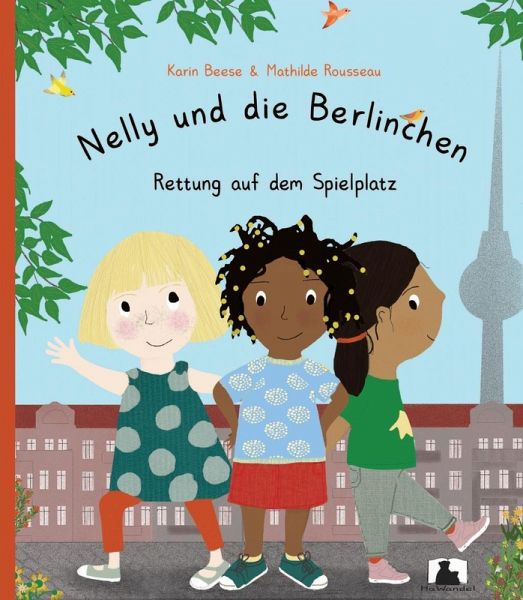
Nelly und die Berlinchen
 In 2019, 'Treasure Hunt', the second book of the Nelly series, was released.
Author Profile

Karin Beese grew up in Sachsen, Germany. 
She studied Communications and Mathematics in Dresden. Beese has worked in environmental politics and development for many years and currently lives and works in Benin (since October 2019). 
She is the founder of the HaWandel Label and has worked with producers in Cameroun to create a fair and transparent pricing system for their products. She is the mother of three girls and her interests include diversity and empowerment, global justice and sustainable environments.


The author was kind enough to answer the questions below and talk about her first experience as a writer of children's books. I have previously discussed her first Berlinchen book in one of my earlier blog posts entitled 'Being Different being me' which you can read here.


Can you please introduce the Nelly und die Berlinchen series to our readers?
Nelly und die Berlinchen is a Berlin-based imaginative picture book series. Pre-schoolers can immerse themselves in the everyday adventures of the three friends Nelly, Amina and Hannah. Written in verse, the Berlin girls are never out of ideas. They have fun, disagree but always work out their problems together. The books present non-discriminatory diverse illustrations with special attention to skin colour, religion and family structures. They focus on friendship, family and the environment in the lives of children and bring a smile to the faces of parents and older siblings.


You crowdfunded and self-published the books. Why?
We crowdfunded the printing of both our Berlinchen books. We first wrote to big publishing houses but waited for months without a reply. What’s more, we had heard that publishers sometimes quite heavily influence the book’s layout and we really wanted to maintain our independence. That’s the reason I started my own small publishing house, HaWandel. It was actually quite simple but of course, a great risk as well. I had to self-finance the printing of the first edition of the first Berlinchen book. The positive feedback from the crowdfunding initiative was very encouraging and I rounded this off with my private savings to finish the project.


What was the reception of your two books like?

The feedback for both Nelly und die Berlinchen books has really surpassed our expectations. Even now, four years after the first publication, we still regularly receive mails or online reviews of our first book and people all over Germany thank us for creating it – parents joke about being sick of reading the story to their kids or we hear from grandparents who are grateful for having finally found the perfect birthday present for their grandkids. We also receive quite moving responses, like that of a mother whose daughter can’t get enough of the book because there is finally a father in it who looks like hers! Our experiences through reading presentations also help us appreciate how differently kids relate to the individual characters of the book. We intentionally created open characters. In the second book of the series, the mother of one of the Berlin girls is pictured together with another woman. While for some kids it is obviously the grandmother, for others it is clear that it’s the mother’s girlfriend. That’s the beauty of the two Nelly und die Berlinchen books – children have a lot of room to use their imagination and creatively identify with the characters.


Beese introduces her books and their context in German on her website hawandel.de


Why do you think there are so few Black protagonists in German picture books? Is there opposition from publishing houses?

To be honest, I really cannot say. You could reach that conclusion when you look at the books out there. On the other hand, established publishers choose on average one out of every 200 book propositions and I have no idea how many authors create books with Black protagonists. There is definitely not enough of such books and it is very important that more authors create them and customers explicitly request them. In the last few years, I have received requests from authors asking if I could also publish other books with very diverse characters. That was not originally my plan but I certainly can see myself doing it. But it should be books like Nelly und die Berlinchen - creative stories which reflect diversity in the everyday lives of children and not books that ‘explain’ that we are indeed all equal. I believe a lot of new books are being created at the moment and I would be happy to work with the authors.


How would you describe the current situation of racism and discrimination in Berlin/Germany?

Racism and discrimination are big problems in Germany and also in many other countries. There are of course local and regional differences but the underlying difference is really whether racism is more direct or indirect. Black people and People of Colour are considerably affected, as a result. Many families I know, for instance, carefully consider their holiday destinations because they want to feel comfortable and safe where they travel without being constantly stared at. There are of course also positive trends in politics and increasing numbers of individuals and companies that are actively engaging with diversity and intersectionality. At the same time, the discussion continues to overwhelm a lot of people and therefore the gap between an engaged discussion and its rejection is becoming wider.


What is needed, in your opinion, to advance the debate here? What role can children’s books play?

We need to become more actively engaged in showing and reflecting what real diversity in Germany and Europe could look like on the ground, in everyday situations – in television, in the news, in cinema and also in children’s picture books. We unfortunately continue to see the same stereotypes being reproduced. One of my daughters once asked me whether women or dark-skinned people could also be police officers. I immediately went in search of picture books with Black or female police officers, which in Germany, is almost non-existent.

Kids love books and books influence at a very young age how kids perceive the world. This is why diverse characters aren’t only important in empowering Black kids or Children of Colour but also white kids. When I identify with a brave, sporty girl in a book and her mother wears a head scarf, the next time I see such a girl at the playground, I would also want to get to know her instead of being sceptical. It is also important that diverse characters are not always presented as perfect or always doing the right thing. Diversity is not ‘good or bad’ but simply normal.


Fotogalerie
'Saving Teddy', the first book in the series, was published in 2016

And finally, what is your favourite children's book?


Der kleine Angsthase - The little scared rabbit (Angsthase also means scaredy-cat). I’ve loved this book since I was a child! It is comforting to see how the little rabbit overcomes his fear and even protects his small friend from the fox. It is nonetheless a pity that he first has to be a ‘hero’ before he is accepted by the other rabbits. What’s funny is that our youngest daughter identifies with the fox and doesn’t like it when he is chased out at the end. It is great when a picture book presents different characters you can identify with or where children can put themselves in the shoes of others.

Wednesday, 15 April 2020

Homemade Love by bell hooks


Decolonising the Imagination


Hardcover Homemade Love : Picture Book
This picture book was published in 2002 and is intended for ages 2 to 6 years. hooks' first children's book was titled 'Happy to be Nappy' and was released in 1999. In 2008, hooks published Grump Groan Growl, a book that embraces the myriad feelings children experience and a warm acceptance of rage and anger.


‘Any Black child that has a healthy self-esteem will know how to deal with racism…any White child that is taught to be loving is not going to be a racist’ (hooks)


'the media has bomdbarded us with stories telling the public that little black children (and we are talking here primarily about girl children) prefer white dolls to black dolls, and think that white children are cleaner and nicer. The white-dominated media presents this knowledge to us as if it is solely some defect of black life that creates such aberrant and self-negating behavior, not white supremacy' (Sisters of the Yam, bell hooks)


bell hooks emphasises the role of imagination in resisting domination. I have the impression that nowadays a vast majority of picture books are unimaginative. They do transport you into wonderful imaginary worlds but many of them leave you wanting and yearning....for blonde hair and blue eyes; they leave you with a dislike for things that are brown and black, they leave you with a void and a confusion and with a vocabulary that doesn't necessarily fit your world. My brown-skinned 3-year-old picks up a light pink coloured pencil and says convincingly that it's the colour of skin. My five-year-old always colours the girls' hair blonde because it's more beautiful, she tells me and my little one protests or cries when I try to colour a face brown or black. 


White Supremacist Capitalist Patriarchy – big words that have become hollow from use and misuse. But not with bell hooks. Homemade love is about empowerment and resistance…but without the floodlights, loudspeakers and fanfare of 'diversity'. It is about resistance through love, healing, bonding…and all of this packaged and illustrated in a playful, flighty, poetic, kinetic style that opens up the book and invites the reader to partake in, seek out and sow this seed of love.


Reading the picture book Homemade Love with my kids is a simple act of joy and sharing. My little girl laughs with the girlpie protagonist hanging from her daddy’s legs and my older one happily reads aloud with me, ‘there is no all the time right. But all the time any hurt can be healed’. Homemade Love is a little big book with deceptively simple sentences that lets children know that they deserve and have a right to be loved. Making mistakes is part of life, hurt can always be healed, peace can be made again with the world… and the tender support of parents in guiding and loving us through all of this is crucial.

Girlpies have the space and cosiness at night-time to process all the things they experienced during the day. In this space of safety, love and alone-time, the little girlpie knows her place in the world, isn’t afraid of the dark place ‘cause everywhere is home’. 


My 5-year-old asks me at the end of our reading, ‘is it true that everywhere is home?’. Oh yes, I say. This comforting well-being that you carry within you…this little ‘Lichtergarten’ (our lit-up inner garden’) as Soheyla Sadr puts it in her picture book ‘Anne und Pfirsich’ is all the ‘home’ we need for self-actualisation, …to imagine and realise our world and to be at one with it.


Shaking Binarisms out

‘We live in a nation that is incredibly diverse but our language is incredibly binary…so we have to work to be inclusive’, notes bell hooks in an interview with Connie Doebele. And this is what bell hooks’ picture books do – they twist the language out of this binarism, let the words jump up and out at you. The words are ventilated, become almost free for each and every child and parent to dwell on, caress or interact with. 


The starting point of Homemade Love isn’t diversity or any of the other catchwords that we parents latch on to in the hope that our children can experience the diverse world that we live in. bell hooks is wary about children's books that start off with a negative - 'my hair is unruly and difficult to manage but I love it just the same'...'I am told by my classmates that I can't be Peter Pan because I'm not a boy and I'm Black but I'll show them'..and the list of examples go on and on. Too many of our children's picture books are stuck in this binarism; telling Black kids and kids of colour that the world is a harsh place for them, that they are not seen as equals, something is 'wrong' with their hair, their colour, their smell, their origin, their religion...but 'WE' will be your friend DESPITE this. We may have been decolonised but the minds and imaginations are still reeling from the stupor of colonisation.


‘How do we use our imagination in the service of our well-being?’, hooks urges us to ask ourselves. When the girlpie protagonist of Homemade Love lies in bed at night, knowing she is loved, knowing the arms that held her are still holding her, she is equipped to be at one in and with the world.

bell hooks has often joked – ‘I’m not happy, I’m an intellectual, how am I going to write books for children?’ But she recognised the energy inside her and wanted to manifest it because kids and more importantly, Black kids and kids of every colour desperately need to see this seed inside them, sow it and enjoy its fruits. Only then can our children begin to see their worth and potential and react to the many hurdles that they face daily.


And finally, I'd like to quote this lengthy passage from hooks' self-help book 'Sisters of the Yam', It shows the depth of the short statements we read in Homemade Love and the deeper meanings behind some of them. In this quote, she talks about embracing darkness and instilling a love for and comfort in it, especially among kids:


In a space before time and words, the world was covered in a thick blanket of darkness. It was a warm and loving covering. Since it was hard for the spirits who inhabited this space to see one another they learned to live by and through touch. So if you were running around lost you knew you were found when arms reached out in that loving darkness to hold you. And those arms that held the spirits in that beautiful dark space before time are holding us still. This is a little origin story I made up. I thought of it one day when I was trying to explain to a little brown girl where the babies lived before they were born—so I told her they lived in this world of loving darkness. I made up this story because I wanted this little brown girl to grow up dreaming the dark and its powerful blackness as a magic space she need never fear or dread. I made it up because I thought one day this little brown girl will hear all sorts of bad things about the darkness, about the powerful blackness, and I wanted to give her another way to look at it. (bell hooks, Sisters of the Yam, pg 92)

Monday, 13 April 2020

My little adorable pink princess. Subverting the princess template in the Grace picture book series

White English writer Mary Hoffman came up with the Grace Series in the early 1990s. Here in Germany, only the first book Amazing Grace has been published (Alibaba Ffm, 1999). Grace loves stories and acting and wants the role of Peter Pan in the school play. Only problem is, she is a girl and she is Black. Her nana and mother encourage her to give it a try and her determination leads her to question established roles along gender and race constructs.

Book - Amazing Grace by Mary Hoffman

I recently checked out some other titles in the series like Princess Grace, a good book to begin reading with the little princess fans who adore wearing pink or purple and cannot tire of their favourite Grimm and Andersson fairytales, popularised and commercialised by Disney.


Take a look at Mary Hoffman's article published in The Guardian which shows her disgust for pink passivity in picture books and the harm it continues to inflict on girls all over the world:

'Down with princesses, I say! And fairies. And unicorns, rainbows, ponies and mermaids. And pink. And possibly purple, too, especially in conjunction with pink and definitely if there is any silver glitter involved. I'm sick of it all. Young girls growing up today are offered an almost exclusive diet of synthetic, comercially exploitative pap'.

This was one reason she decided to create the picture book Princess Grace, featuring the Black protagonist Grace who discovers princesses in different hues that actually do things rather than just look pretty and wait for a prince to come along. Other titles in the series like Encore, Grace, a junior reader chapter book, further open up and question the conventional princess stories by having Grace and her classmates reinterpret the roles of their favourite fairytales, like Sleeping Beauty. Perhaps Hoffman's main reason for publishing the Grace Series was to offer her dark-haired, princess-loving daughter (whose father is half-Indian) another version of what a princess can look like and be.

Self-hate among children of colour; obsession with blue-eyed blondness as the epitome of beauty; rejection of anything brown or black as ugly; lack of self-esteem; being the victim of racist remarks and discrimination...these are real problems that start at preschool and get dragged into adult life in post-colonial societies where white supremacy propaganda is alive and kicking.

In an interview with Booktrust, Hoffman calls for more books on diversity and talks about her own personal interests in representing diversity: 'More than ever, children need books that are exciting, surprising and stimulating. They need 'mirror' books and 'window' books: stories that reflect themselves but also all sorts of lives they have never imagined'.

It should be noted that these books start with the premise that being Black is somehow a barrier to overcome. The series then introduces positive figures in history (a Black star ballerina, Nigerian and Chinese princesses) to look up to or emulate thereby empowering child readers. Blackness is thematised and it could be argued that in the title books Grace and Family and Boundless Grace, Africa is exoticised. The author made her first visit to AFRICA..the Gambia is apparently too small to make the point - to meet the people who inspired the illustrations of Grace and her family. She admits that she couldn't have written the book without this journey: 'It was my first trip to Africa which was mind-blowing in itself. And I met the models for Grace, Ma and Nana for the first time. I swam in the Atlantic Ocean with them, danced with a witch doctor and stroked a huge crocodile. I couldn't have written the book without going there'.


For readers interested in Black protagonists whose colour isn't at the centre of the text, see the picture books by Toni Morrison, bell hooks or Ezra Keats.

Tuesday, 14 January 2020

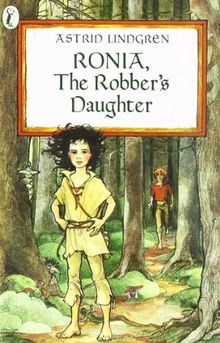
Ronia, the Robber's Daughter by Astrid Lindgren

Many readers associate Astrid Lindgren with her character Pippi Longstocking and rightly so - Pippi's fame has long surpassed her fictitious creation and the colossally strong girl has carved a world for herself, much like Collodi's Pinocchio who ceases to be a wooden puppet and becomes a 'real' boy of flesh and blood.


Ronia, the Robber's Daughter (Puffin Books)
Published in Swedish in 1981 

But Lindgren has created other longlasting characters, also worthy of mention and praise. There's Lisa from the Bullerbü world, there's Mio, the orphan child who goes on a magical journey of love, friendship and courage and then there is Ronia, the robber's daughter who defies her father and befriends the rival robber's son, Birk. The robber's world may at one time have been fun and adventurous but Ronia and Birk want nothing of it and their quest to create a path for themselves and to find themselves in the closed robber circle is one of adventures, love, hope, danger and friendship. This is a book set in the forested world inhabited by fearsome harpies, gray dwarves, rumphobs and murktrolls. The seasons and the mysterious forest with its warmth and hidden dangers are as much characters as the robbers and the two children who become one with nature.

It's a story about bonds and conflicting relationships, about a love between a father and a daughter and about holding on while letting go at the same time. Ronia's fearless and fearsome father Matt has disowned his daughter when she betrays him by crossing over to the enemy's side in order to save the captured Birk's life. Ronia struggles between love for her father and the resentment she harbors because of his generations-long enmity with the Borka clan and his theiving ways. But Matt also knows that to keep his daughter he has to give in and make peace.

It is a story about survival, about living in a lawless marginalised world and about acceptance. Ronia's escape into the forest and her coming of age will capture young readers who will share in her passions, fears and narrow escapes. The timeless character Ronia will always be remembered for her humour, fearlessness and strength. A book well worth reading!

Saturday, 16 November 2019

The Everyone Book

'If you can make people laugh, you can tell them anything...comedy cuts deeper', says Rushdie.

Here is Salman Rushdie talking with Mitchell Kaplan about his new book Quichotte. Towards the end of his fascinating, meandering chat where he reveals some of his inspiration for his novel and the multiple threads that intertwine in it, he comes up with the term an 'everything book'. Sounds like a just blog title! I like the wittiness and all the depth it encompasses. He confesses that that's the book he has been trying to write all his life.
In fact, an everything book, in my mind, reflects and tries to showcase or speak to as much of reality as possible. Maybe instead of diversity books, we can have the 'everyone book' ;)!

Sunday, 10 November 2019

Sycamore Wings

Shake me empty
the bowels overflow
 a river of tears,
rage pushed in a vortex.
I long to be free.
Shake me still,
then let me be,
blinding words infested wounds,
navigate my head
piercing blue light
inhale exhale a smile
rage swimming forth
breathing hard
out of breath
echoing void


Jekyll hydes waiting for the kill
looking through the glass pane
nobody knows he is there
just an angel with a spear
open arms smiling clear

but the see-through rage cannot cover up
the smears
of the authorities
the ondulating fence
of barbed wire,
of splintered wood,
of mossy insignificance
longing for respite
pierce the fear,
 it's empty, you see

Perch on that perfect sycamore seed,
grip the fragile blades,
ignore the greed
tumble dizzily
safe landing mission completed

wait for new buds to sprout,
bring out the talking cricket
and the rhino
the roots hold down and push
OUT
this magical being
levitating
and the air still stinks


Thursday, 7 November 2019

'All of us look alike to white people', Americanah by Chimamanda Ngozi Adichie

'I think we need to become more comfortable with being uncomfortable', says Adichie

An extract from the novel Americanah, which offers a pointed analysis of race and being Black in America:

'At the checkout, the blonde cashier asked- 'Did anybody help you?'
Yes, Ginika said
Chelcy or Jennifer?
'I'm sorry. I don't remember her name'-
'Was it the one with long hair?', the cashier asked
'Well, both of them had long hair'
'the one with dark hair?'
Both of them had dark hair.
... Ifemelu said, 'I was waiting for her to ask, 'Was it the one with two eyes or the one with two legs?'
'Why didn't she just ask - was it the Black girl or the White girl?'
...'Because this is America. You're supposed to pretend that you don't notice certain things' (Extract from pg. 126-7, Americanah by Chimamanda N. Adichie)


We are caught up and preoccupied and tied up with words. Words hurt or twist or veil reality, descriptions define and encase, reinforce or subvert; words bring people closer or create a chasm between them. This is the danger of being politically correct - our mentalities do not change, prejudices aren't adequately addressed, discriminations are swept under the carpet and we try to hide the obvious because we don't want to or are not ready or cannot face lived and living history.

'Identity is something one always negotiates, but it's also often something external', notes Adichie.
'To read literature is to become alive in a body that is not your own', she adds in her chat with The Economist's Sacha Nauta.
'In talking about diversity, we have to make room for discomfort', she underlines in the same chat.


Americanah caught my attention for several reasons:


Its refreshing insight into slices of Nigeria, USA and to a lesser degree, England; the young, educated mobile characters trying to pave a path for themselves in the midst of uncertainty, capitalist wrecklessness and oscillating fortunes

The desolating hypocrisies of race in the US and all the nuances of being Black there; the identity crisis of non-American Blacks and how they fare in their adopted society.

The humorous yet revealing layers of changing accents and situating oneself - the fluid, flowing, fragile identities and the awakening of a grounded, confident self after much self contemplation

The trials of an immigrant, both legal and undocumented; the slow dehumanising process, the steady ascent, the travails of everyday life, the small pleasures and the lucky/unlucky outcomes.


All the different female profiles it provides - of women both defeated and triumphant, subservient and empowered, fighting to stay human, to stay beautiful, to become independent.


                                                                    ***


And in the spirit of this blog, which focuses so much on (the lack of) positive figures for non-White children in (mostly) German picture books, it is worth quoting Adichie's non-fiction book, Dear Ijeawele, or a Feminist Manifesto in Fifteen Suggestions. It's a response to how you can make your daughter a feminist, asked by one of her friends. Some of her answers extend beyond creating a 'feminist' child. They are 'suggestions' for creating a whole individual, confident in her skin, unafraid to stand out because she may have a different opinion, taste and yes, skin colour - 

Be a full person; motherhood should not define you as a person, as important and precious as it is; Rejecting likability, your job is not to make yourself liked but to be your FULL SELF, 'a self that is honest and aware of the equal humanity of other people'; 
Teaching difference and making it ordinary and normal, teaching without attaching value to difference.
These 'suggestions' are not only for our kids of course. If we keep them in mind, the glasses we wear and through which we see the world, will suddenly make us see, not only ourselves, but others with a different clarity and light.